
TRAINING
Kemerovo and Amur regions, Khabarovsk Territory
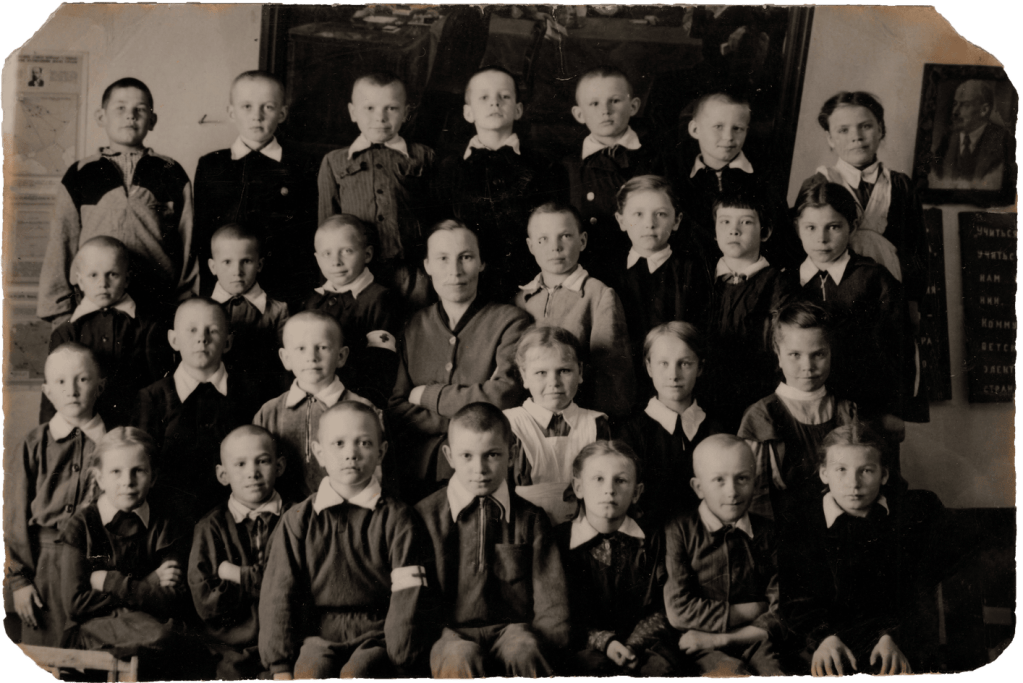
Bohdan Kostelnyi (third on the left in the last row) among his classmates, Prokopyevsk, Kemerovo region, 1955
Source: Private archive of Bohdan Kostelnyi
bOHDAN KOSTELNY
deported in 1947 to the Kemerovo region
In 1952, I went to school. In 1953, Stalin died. I recall a teacher coming to a class, there was a book ‘The Native Speech.’ She opened the book, and it had a portrait of Stalin on the first page. And she was crying: ‘Look, children, our Joseph Vissarionovich Stalin died.’ And all the children were crying. And my brother said, ‘It’s good that he died. Now we can go to Ukraine.’ And there was a boy, a Tatar, who informed on that to the school principal. The school principal called Dad and said, ‘Look, you could end up in jail.’ But that was covered up because the director was a normal person.

Roman Skytskyi (center, second row) among his classmates, Khor village, Khabarovsk Territory, 1954
Source: Private archive of Lidia Kitsyla (Skytska)
TAMARA VRONSKA
historian
The Soviet government formally demanded that the management of the special settlements involve all school-age children in the education process. The main goal was to oppose the Soviet ideological upbringing to the influence of the family and to accelerate the process of domestic and linguistic assimilation. By the end of 1949, 15,343 school-age children from Western Ukraine were in exile. However, due to the banal lack of clothes, shoes and textbooks, illnesses and malnutrition, as well as for the urgent need to help adults, 28% of them did not attend school. Those who completed school studies did not have the opportunity to obtain higher education due to mobility restrictions. Therefore, young people were employed in vocational craft schools and schools of factory training. Some still managed to enter universities but only outside the off-limits area.
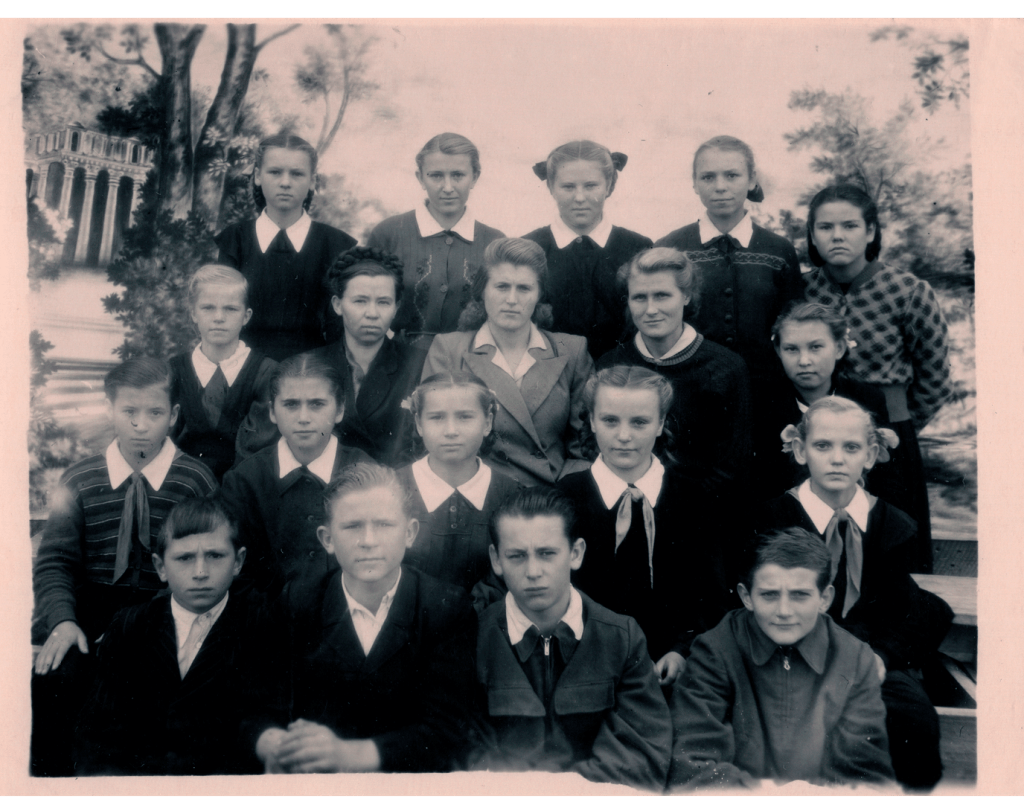
Maria Zavadka (second on the left, second row) when at school in Amur region, 1950s
Source: Private archive of Maria Kalyniak (Zavadka)
LIA DOSTLEVA
cultural anthropologist
The genre of school photography has remained unchanged for decades. In this collection, we can see photos taken in the classroom, in the open, and even in the studio, with the painted landscape in the background. In the first photo, we can see a portrait of Lenin in the background, his quotes, a map, and a fragment of a large painting that for some reason is hanging at an angle. We can also see that children of different ages were photographed. Almost all of them had white collars sewn to their poor clothes. The painting shall be mentioned separately. It is a reproduction of the work of a Ukrainian Soviet artist, Serhiy Hryhoryev, ‘Discussion of the Fail Grade’ (1950). It depicts a meeting of the Komsomol committee examining the personal file of a high school student who received a failing score of two. For this painting, the author was awarded the Stalin Prize, and in 1956 it was exhibited in the Soviet pavilion at the XXVIII Biennale in Venice. In other words, the same image could be viewed by children forced to grow up in the terrible conditions of special settlements, and by elegant visitors to one of the most famous exhibitions of modern art.
 After SIlence